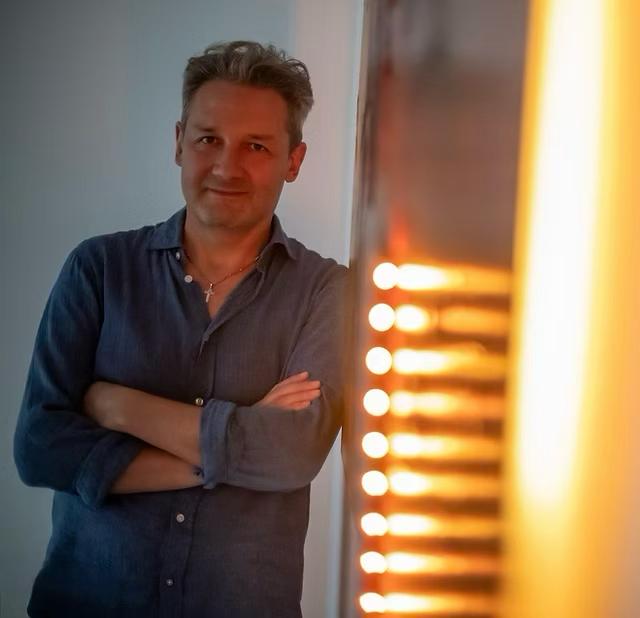
ANDREW MANAYLO
There is something inexplicable—almost primal—in the way inspired paint meets the canvas.
The art of András Manajló (known internationally as Andrew Manaylo) captures precisely this
raw yet poetic energy, transforming his work into an ongoing, passionate dialogue with both
the created world and an inner, invisible reality.
András Manajló was born in 1970 in Uzhhorod into a family where art was not merely a
profession, but a native language. His grandfather, Fedor Manajló, was one of the founders
of the Transcarpathian School of Painting—and of the so-called “Carpathian
Barbizon”—playing a defining role in shaping the region’s visual identity. His father, Iván
Manajló, also worked within this same artistic philosophy. The optimistic outlook
characteristic of the Transcarpathian School, along with a deep affinity for pure, intense
colors, was present in his work from the very beginning. At the same time, his intellectual
curiosity led him toward some of the most prestigious institutions.
In the early phase of his career, he established a strong academic foundation. During his
figurative period, his canvases were dominated by anatomically precise female figures,
ethereal ballet dancers suspended in motion, and galloping horses raising clouds of dust. Yet
even then, it was evident that the artist was not concerned with mere photorealistic
representation. For him, form was never an end in itself, but a vehicle for expressing
movement, inner dynamics, and underlying tensions. Over time, these figures gradually
dissolved, giving way to the full autonomy of color, light, and rhythm.
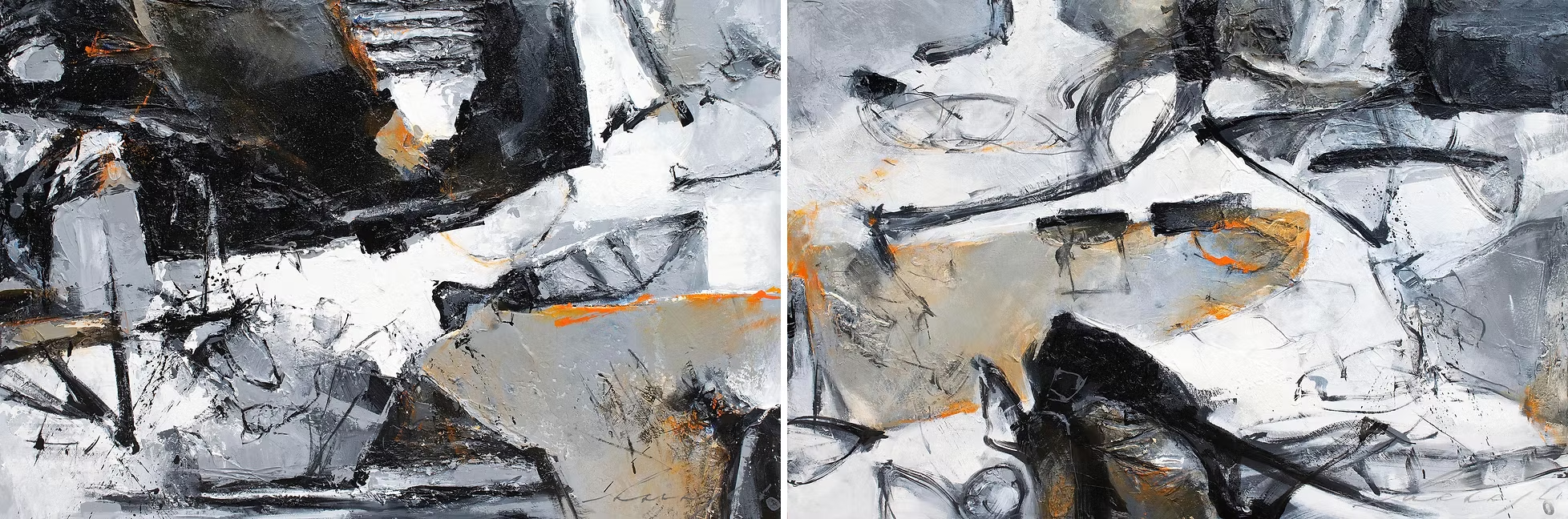
As formal constraints receded, the artist arrived at the pure, elemental force of abstract
expressionism. Paint is often applied thickly to his canvases, with free, dynamic, almost
storm-like brushstrokes. Colors surge and collide, then suddenly resolve into moments of
calm. This spontaneous, deeply emotional mode of painting creates a rare sense of
pulsation, as if the artwork itself were breathing—constantly in motion. Each viewer
encounters a different inner resonance before the canvas: joy, longing, melancholy, or
overwhelming passion. The artist gives form to subtle, intangible human
experiences—“voices of the soul”—for which we have no words, only colors and textures.
A turning point in Manajló’s life was his extended journey along the French–Italian Riviera.
This experience brought him into contact with the warmth of the Mediterranean world, the
crystalline, light-filled waters of the Côte d’Azur, and a life-affirming sense of lightness that
opened an exciting new chapter in his art.